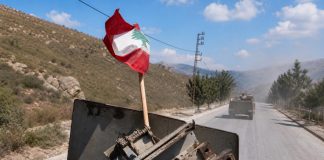
Israeli strikes in southern Lebanon and renewed rocket fire towards northern Israel have placed fresh pressure on a US-mediated ceasefire, underlining the fragility of efforts to contain the conflict along the Israel-Lebanon border.
The ceasefire between Israel and Lebanon is under renewed pressure after Israeli strikes killed four people in southern Lebanon and rocket fire was reported towards northern Israel on 25 April.
The latest escalation followed a series of Israeli strikes in southern Lebanon, where Lebanon’s Health Ministry said four people were killed in attacks on a truck and a motorcycle in the Nabatieh district. The Israeli military said it had struck Hezbollah rocket launchers in several locations in southern Lebanon, describing them as loaded and ready for use against Israel.
Israel’s prime minister, Benjamin Netanyahu, then instructed the military to strike Hezbollah targets “with force” after rockets and a drone were launched from Lebanon towards northern Israel. The Israeli military said two rockets were fired from Lebanon, one of which was intercepted, while the other landed in an open area. It also said a suspicious aerial object was intercepted. No casualties were reported in northern Israel.
The incidents come shortly after a ceasefire extension announced with US mediation. The truce was intended to reduce fighting along the border and create space for further diplomatic work, but the events of 25 April show how limited its practical effect remains. Both sides continue to frame their actions as responses to violations by the other, while civilians in southern Lebanon and northern Israel remain exposed to renewed fire.
The military situation remains centred on southern Lebanon, where Israeli forces have continued to strike what they describe as Hezbollah military infrastructure. On 25 April, the Israeli military said it had targeted rocket launchers in the areas of Deir El Zahrani, Reman and Al-Saamiya. It said the launchers posed an immediate threat to Israeli civilians and soldiers.
Lebanese authorities, meanwhile, reported deaths from Israeli strikes in civilian areas. The Lebanese Health Ministry said the four fatalities on Saturday came from two separate Israeli airstrikes in southern Lebanon. The deaths added to the political pressure on Lebanon’s government, which has limited control over Hezbollah’s military decisions but bears the consequences of further escalation on Lebanese territory.
The renewed exchange illustrates the central weakness of the ceasefire. It appears to have reduced the intensity of fighting at some points, but it has not produced a stable security arrangement along the border. Israel continues to insist that Hezbollah’s presence and military infrastructure in southern Lebanon are unacceptable threats. Hezbollah continues to present its actions as resistance to Israeli operations and to Israeli presence in contested areas.
For Lebanon, the risk is that a limited border conflict becomes a wider national crisis. Southern communities have already faced displacement, infrastructure damage and repeated strikes. Further escalation would increase pressure on the Lebanese state at a time of deep political and economic strain. The government in Beirut has little room to absorb a broader conflict, yet it remains exposed to decisions taken by armed groups operating from Lebanese territory.
For Israel, the issue remains the security of northern communities and the prevention of Hezbollah fire across the border. The latest rocket launches, even without casualties, give Israel a clear security argument for continued strikes. However, a pattern of reciprocal fire also risks eroding the ceasefire to the point where the diplomatic framework becomes largely nominal.
The wider regional context makes the border more volatile. The Israel-Lebanon front is linked to broader tensions involving Iran, Hezbollah and the war in Gaza, even when individual incidents are localised. Any escalation in southern Lebanon can therefore affect calculations in Washington, Tehran, Beirut and Jerusalem. For Europe, the concern is not only humanitarian. A wider conflict could affect regional stability, maritime security in the eastern Mediterranean and diplomatic efforts to prevent another full-scale war involving Lebanon.
The latest events also raise questions about enforcement. A ceasefire that relies on both parties’ restraint, but lacks a sufficiently effective monitoring and enforcement mechanism, is vulnerable to rapid deterioration. If rocket launches, drone activity and airstrikes continue, the ceasefire may survive formally while failing to reduce the risk to civilians.