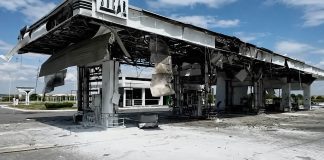
Hours-long queues and purchase restrictions from the St Petersburg region to Siberia are moving the effect of Ukrainian energy strikes beyond industrial statistics and into the daily lives of Russian drivers.
Russia’s fuel shortage is becoming a domestic political story as drivers face long queues, filling stations impose purchase limits and regional supply problems spread far beyond areas close to Ukraine.
On-the-ground reporting from the Leningrad region around St Petersburg describes motorists waiting for hours to buy petrol. Similar restrictions have been reported across parts of Siberia and other regions as repeated Ukrainian strikes constrain refinery output and complicate distribution.
The latest account of queues and rationing across Russia matters because it provides visible evidence of a campaign that has often been measured through estimated refinery outages. The pressure is no longer confined to energy companies, export schedules or occupied Crimea. It is affecting ordinary mobility inside Russia.
A large producer with a refining problem
Russia is one of the world’s largest oil producers, but crude reserves do not automatically provide petrol and diesel. Refineries are complex industrial systems that convert crude into usable products. Damage to distillation units, catalytic crackers, power supplies or internal pipelines can reduce output for weeks or months.
Ukraine has repeatedly targeted those facilities with long-range drones, arguing that fuel production and oil revenue support Moscow’s war. Russia has continued exporting crude even as domestic processing has come under pressure, but that balance becomes harder to maintain when several plants are damaged at once.
The July 6 strike on the Omsk refinery, Russia’s largest, deepens the concern. It followed attacks on other processing sites and on the Baltic ports of Vysotsk and Ust-Luga. The full damage is not yet independently established, but the cumulative pattern has reduced spare capacity and increased dependence on rapid repairs.
Queues are a different kind of war indicator
Industrial data can appear remote to the public. A queue at a filling station is immediate. It consumes time, disrupts work and travel, and signals that official assurances of normality do not match personal experience.
This does not mean Russia is close to running out of fuel nationally. Its energy system is large, and the government can redirect supplies, restrict exports, draw on reserves or arrange imports. Regional shortages can also reflect distribution problems and panic buying rather than an absolute national deficit.
Yet each intervention carries economic and political cost. Limiting purchases inconveniences households and businesses. Restricting exports can reduce revenue or disturb commercial relationships. Imports expose the awkward fact that an oil-producing state cannot refine enough of the products its population needs.
The Kremlin has worked to keep the consequences of the war distant from large urban populations. Fuel queues weaken that separation. They make the cost of protecting distant refineries and sustaining wartime logistics visible at the petrol pump.
The campaign is aimed at systems, not one plant
EU Global has examined how Ukraine’s refinery campaign is feeding into wider Russian economic pressure. The current shortages are a more direct indicator because they connect damaged processing capacity with consumer access.
Ukraine’s strategy appears cumulative. A single refinery strike can be repaired or offset. Repeated attacks on processing, storage, pipelines and export terminals force Russia to manage several bottlenecks simultaneously. Moscow must also distribute finite air-defence systems across a vast number of industrial sites.
The result is an attritional contest between attack, repair and adaptation. Ukraine needs to sustain long-range operations and select targets with real economic value. Russia needs to intercept drones, restore units and prevent local disruption from becoming a national crisis of confidence.
Economic and political limits
Fuel shortages can feed inflation through transport and agricultural costs. They can also complicate military logistics if high-quality diesel or aviation fuel becomes scarce, although public queues alone do not prove that armed forces are being deprived of supply. Governments normally protect military and essential-service demand first.
That prioritisation can intensify civilian pressure. If motorists see official users supplied while public stations remain restricted, resentment may grow. The impact will depend on duration: a short disruption is manageable, while repeated shortages across several regions can alter expectations.
The most useful indicators now are refinery throughput, wholesale fuel prices, regional purchase limits and the speed at which damaged facilities return to service. Russian authorities will seek to contain both the shortage and the narrative around it.
Ukraine’s strikes have not disabled Russia’s energy economy. They have, however, begun to challenge one of Moscow’s central wartime assumptions: that the country can wage a long war while insulating most citizens from its operational consequences.
The queues outside St Petersburg and restrictions farther east do not mark collapse. They mark transmission. Damage at refineries and logistics nodes is passing through the system and reaching the public, turning a long-range military campaign into a domestic test of patience and confidence.