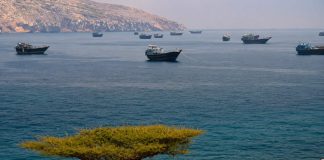
A gas carrier assessed to be carrying Iranian liquefied petroleum gas has passed the formal US blockade boundary, highlighting the difficulty of enforcing maritime restrictions around the Strait of Hormuz.
A liquefied petroleum gas tanker previously associated with Iranian cargoes has crossed the formal boundary of the US naval blockade around Iran, according to ship-tracking data, in a development that points to continuing uncertainty over maritime enforcement in the Gulf of Oman and the Arabian Sea.
The very large gas carrier Tara Gas passed late on Tuesday across the line declared by the United States, running from Oman’s Ras al Hadd to the Iran-Pakistan border. The vessel was then tracked moving south-east through the Arabian Sea, according to available ship-tracking information.
The crossing does not necessarily mean that the vessel evaded an interception attempt. However, it is significant because the declared line has become a practical reference point for shipowners, insurers and vessel masters operating in waters where commercial shipping is now exposed to competing military instructions, seizure risks and possible attack.
The US Navy announced the blockade last month after Iran tightened its control over traffic around the Strait of Hormuz, a key passage for oil, gas and petroleum product exports from the Gulf. Since then, American forces have intercepted several vessels beyond the declared boundary, while other ships have adjusted routes, delayed voyages or limited their public tracking signals.
US Central Command said this week that the aircraft carrier USS Abraham Lincoln was continuing operations in the Arabian Sea as part of the blockade enforcement effort. It said US forces had redirected 65 commercial vessels and disabled four since the operation began, according to a public statement.
The Tara Gas had previously attracted attention under its former name, Gas Global, because of reported links to Iranian LPG shipments. In its current voyage, the vessel is assessed by ship-tracking platforms to have loaded Iranian liquefied petroleum gas in early May before heading out of the Gulf.
The vessel’s registered owner is listed as Global Gas Inc., based in the United Arab Emirates, while its manager is identified as Matrix Maritime Solutions FZE, recorded as sharing the same address. The available reporting said Matrix Maritime Solutions did not respond to a call to the listed number.
The episode underlines the difficulty of enforcing a maritime blockade across one of the world’s most congested and commercially sensitive corridors. The Strait of Hormuz and adjacent waters remain central to exports of crude oil, LPG and liquefied natural gas from the Gulf, including cargoes bound for Asian markets.
The wider regional shipping situation remains unstable. A second Qatari LNG tanker recently crossed the Strait of Hormuz towards Pakistan, part of a limited flow of gas shipments continuing despite the conflict and the restrictions placed on shipping routes through the area, according to vessel movement data.
At the same time, Qatar has asked vessels near its main LNG export hub at Ras Laffan to switch off transponders as a safety measure, a step that has contributed to a wider pattern of ships disappearing from public tracking systems across parts of the Gulf, according to maritime reporting.
For Washington, the Tara Gas passage presents a test of the blockade’s credibility. A declared line can guide enforcement, but its practical impact depends on whether vessels believe they are likely to be intercepted, diverted or disabled if they cross it without authorisation.
For commercial operators, the calculation is more complex. Tanker owners, charterers and insurers must now assess not only sanctions exposure, but also the risk of military action, delay, seizure or loss of cover. That uncertainty is likely to keep freight markets unsettled even if individual ships continue to move through the region.
The case also illustrates how Iranian energy exports may continue through vessels with complex ownership, management and flagging arrangements. Such structures have long complicated efforts to enforce sanctions and maritime restrictions, particularly where cargo origin, beneficial ownership and routing are difficult to establish in real time.
For now, the Tara Gas crossing suggests that the US blockade is disrupting traffic but has not fully halted Iran-linked maritime movement. The coming days will show whether Washington treats the incident as an isolated crossing, tightens enforcement, or seeks to avoid further escalation in one of the world’s most sensitive shipping corridors.