Former British Prime Minister Boris Johnson has taken to social media to issue a rallying cry to European nations, urging them to stop fixating on Donald Trump and instead focus on supporting efforts to end the war in Ukraine.
Johnson’s comments have sparked significant debate, particularly his defense of Ukraine’s wartime governance, his critique of European reluctance to release frozen Russian assets, and his interpretation of Trump’s statements as strategic rather than literal.
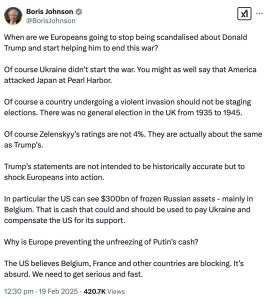
In his social media post, Johnson questioned why Europeans remain preoccupied with Trump’s controversial remarks rather than taking decisive action to assist Ukraine.
He argued that instead of being “scandalised” by Trump, European nations should work with him to bring the war to an end.
While many European leaders have expressed concerns over Trump’s unpredictable stance on NATO and Ukraine, Johnson appears to suggest that the former U.S. president’s influence could be leveraged to accelerate a resolution to the conflict.
Defending Ukraine’s Lack of Elections
A key point in Johnson’s statement was his defense of Ukraine’s decision not to hold elections during the ongoing Russian invasion. Critics of Ukrainian President Volodymyr Zelenskyy have pointed out that no elections have taken place since the war began, questioning the legitimacy of his government. However, Johnson countered this argument by drawing a historical parallel to the United Kingdom during World War II, where no general election was held between 1935 and 1945. His argument implies that in times of existential crisis, democratic norms may need to be temporarily adjusted for the sake of national stability.
Johnson also took issue with claims that Zelenskyy’s approval ratings have plummeted to just 4%. He asserted that such figures were misleading and that Zelenskyy’s popularity remains comparable to that of Donald Trump in the United States. While polling data varies, it is widely acknowledged that wartime leadership can bring fluctuating approval ratings, with Zelenskyy retaining strong support among Ukrainians despite growing domestic challenges.
One of Johnson’s most striking remarks, however, was his interpretation of Donald Trump’s statements regarding Ukraine. He acknowledged that Trump’s rhetoric is often inaccurate but suggested that it serves a purpose—to shock Europeans into action. This perspective frames Trump’s controversial statements as a form of political pressure aimed at compelling European nations to take greater responsibility for the war effort. While Trump has at times made ambiguous or contradictory statements about NATO and Russia’s invasion of Ukraine, Johnson’s defense implies that his underlying intent is to provoke a stronger European response rather than to weaken support for Kyiv.
Criticism of Europe’s Handling of Frozen Russian Assets
Johnson did not hold back in his criticism of European nations for their handling of frozen Russian assets. He specifically pointed out that $300 billion in Russian funds, primarily held in Belgium, remains inaccessible and should be used to support Ukraine. He questioned why Europe is preventing the release of these assets, suggesting that the U.S. sees resistance from Belgium, France, and other countries as an obstacle to aiding Ukraine more effectively.
The debate over the use of frozen Russian assets has been ongoing, with some European leaders cautious about the legal and financial ramifications of unilaterally seizing the funds. However, Johnson’s position aligns with voices in the U.S. who argue that these assets should be repurposed to compensate Ukraine and the nations supporting its defense efforts.
Johnson concluded with a stark warning that Europe needs to act quickly. He characterized the current hesitation over Russian assets as “absurd” and called for immediate steps to release these funds. His sense of urgency underscores a broader concern that without stronger financial and military support, Ukraine’s ability to sustain its resistance against Russia could be jeopardized.
Main Image: The White House from Washington, DC — #UNGA, Domaine public, https://commons.wikimedia.org/w/index.php?curid=82512510