

For more than four years, the European Union has presented its sanctions regime against Russia as one of the most comprehensive economic campaigns ever assembled. Successive packages have targeted banks, technology, aviation, shipping, energy, luxury goods and thousands of individuals linked to the Kremlin.
Brussels has repeatedly insisted that the objective is straightforward: to degrade Russia’s ability to sustain its war against Ukraine.
Yet every sanctions regime is ultimately judged not by its rhetoric but by its coherence. The controversy surrounding alumina exports from Ireland to Russia illustrates how easily political messaging can diverge from strategic reality.
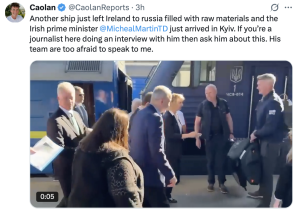
There is no evidence that Ireland has violated European law. Investigations commissioned by the Irish government have found no breach of the sanctions rules that existed at the time.
The Aughinish Alumina refinery in County Limerick, owned by the Russian aluminium producer Rusal, exported alumina under licences that remained lawful under EU regulations.
Independent monitoring reportedly found no conclusive proof that specific shipments entered Russia’s military supply chain.
Legally, that should settle the matter. Politically and strategically, however, it does not.
Modern warfare depends as much upon industrial capacity as it does upon soldiers. Aluminium has become one of the indispensable materials of contemporary defence manufacturing. Aircraft structures, missiles, drones, armoured vehicles and countless other military systems depend upon reliable supplies of aluminium, which itself depends upon alumina as its principal raw material.
Whether a shipment of alumina can be traced directly to the manufacture of a missile is almost beside the point. Every tonne entering Russia’s industrial economy eases pressure elsewhere within the supply chain. Resources that might otherwise have been devoted to civilian production become available for defence. That is precisely why sanctions increasingly focus not only on finished weapons but also on dual-use technologies and critical industrial inputs.
This explains why Ukraine repeatedly urged Dublin to halt the exports long before Brussels moved to tighten its sanctions regime. Kyiv viewed the issue through the lens of strategic capability rather than legal compliance. From that perspective, the distinction between direct and indirect military benefit becomes increasingly academic.
The Irish government’s position has been understandably cautious. Aughinish is Europe’s largest alumina refinery and represents an important industrial asset within the Union itself. Policymakers faced competing priorities: maintaining industrial production, protecting employment, preserving supply chains and adhering to European law while navigating an increasingly complex geopolitical landscape.
Those are legitimate considerations. Governments cannot simply ignore economic realities.
Nevertheless, the affair reveals a broader weakness in the European Union’s sanctions architecture. Too often, sanctions have evolved incrementally, reacting to developments rather than anticipating them. Each package has closed one loophole while leaving another exposed. Industries have adapted, supply chains have shifted, and regulators have frequently found themselves several steps behind commercial ingenuity.
This pattern is hardly unique to alumina. Since Russia’s invasion of Ukraine, policymakers have repeatedly discovered that products considered commercially benign can acquire considerable strategic significance once military production expands. Machine tools, specialised electronics, bearings, precision instruments and industrial chemicals have all become subjects of increasingly detailed export controls.
Alumina belongs within that wider category of strategic materials.
The debate also illustrates an uncomfortable tension between national interests and collective European objectives. Individual member states inevitably seek to protect important employers and domestic industries. Brussels, meanwhile, seeks to present a united geopolitical front. When those objectives collide, political ambiguity often fills the gap.
Ireland has found itself caught in precisely that position. It has complied with the law while attracting criticism from allies who argue that legality alone is an insufficient standard during wartime.
Such criticism should not be directed exclusively at Dublin. Responsibility ultimately lies with the European Union itself. If Brussels believed alumina represented an unacceptable strategic risk, it possessed both the authority and the responsibility to prohibit those exports much earlier. The absence of a ban effectively left member states to navigate an increasingly contentious issue on their own.
That appears now to be changing. Moves to include alumina within a broader sanctions framework acknowledge what many analysts have argued for some time: modern economic warfare requires controls over critical industrial inputs, not merely finished products.
The lesson extends well beyond one refinery in western Ireland.
Sanctions are only as credible as their consistency. Every exemption invites scrutiny. Every loophole creates uncertainty. Every delay risks weakening the political message Europe seeks to project.
If the objective is genuinely to constrain Russia’s capacity to wage war, then policymakers must continually reassess which materials possess strategic value. Waiting until controversy forces action is an inefficient way to conduct economic statecraft.
Europe has demonstrated remarkable unity since 2022, but unity cannot substitute for coherence. A sanctions regime that permits exports of strategically important materials while simultaneously proclaiming economic isolation inevitably invites criticism from both supporters and opponents alike.
Ireland’s experience should therefore be viewed less as a national controversy than as a European case study. It highlights the difficulty of balancing legal certainty, industrial competitiveness and geopolitical responsibility in an era when supply chains have become instruments of foreign policy.
Compliance with the law remains essential. But governments should also recognise that strategic credibility often demands a higher standard than mere legal compliance. As the European Union continues refining its sanctions policy, closing such gaps is likely to prove just as important as announcing the next package of restrictions.
The credibility of Europe’s economic strategy depends not only on the severity of its sanctions but on the consistency with which they reflect the strategic realities of a prolonged war.
Main Image: By Graham Horn, CC BY-SA 2.0, https://commons.wikimedia.org/w/index.php?curid=193840120

