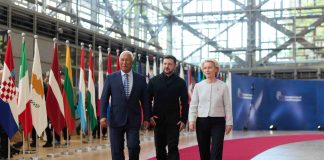
EU leaders have failed to agree on a proposed back-channel to Moscow, exposing a deeper problem for Europe: who speaks for the bloc if Ukraine peace talks advance under US pressure.
European Union leaders have failed to agree on a proposed back-channel to Moscow, exposing a central weakness in Europe’s approach to any future Russia-Ukraine peace process: the bloc still has no settled answer to who speaks for it.
According to Associated Press reporting from Brussels, European Council President António Costa had directed his office to reach out to the Kremlin and proposed a senior official to establish contact. Costa said the purpose was not to mediate or create a parallel negotiating track, but to ensure that the EU could directly convey its interests if negotiations over Russia’s war against Ukraine begin to move.
The proposal did not win consensus at this week’s EU summit. Some leaders supported the need for a communication channel. Others warned that the move could make the EU look like a neutral intermediary between Russia and Ukraine, rather than a political supporter of Kyiv and a sanctions power against Moscow.
That disagreement matters because the diplomatic environment is changing. The United States has led the main Russia-Ukraine negotiating channel, with limited progress. Europe is central to sanctions, reconstruction funding, security guarantees and Ukraine’s EU accession path, but it risks being treated as a payer and enforcer rather than a political actor in any settlement.
The problem of European voice
The question before EU leaders is not simply whether to talk to Moscow. It is who has the authority to do so.
Costa, as president of the European Council, can speak on behalf of the EU’s member-state leaders in certain contexts. European Commission President Ursula von der Leyen can speak for the Commission and has argued that Europe must be able to convey its own interests directly. France and Germany have their own diplomatic weight. The E3 format, including France, Germany and the United Kingdom, has also been floated in wider European diplomacy.
Each option has weaknesses. A Council-led channel may be criticised if member states feel insufficiently consulted. A Commission role may be seen as too institutional for a war-and-peace negotiation. A Franco-German or E3 channel could leave smaller and eastern member states fearing that their security concerns are being handled above their heads.
That is the structural problem exposed by the summit. The EU has become a major wartime actor, but it is not a state. It can finance, sanction, regulate and enlarge. It struggles more when diplomacy demands one voice, fast decisions and political risk.
Ukraine first, but Europe cannot be absent
Several leaders have stressed that any peace process should primarily involve Ukraine, Russia and the United States, rather than elevating the EU into a mediating role. That position reflects a real concern: Europe must avoid creating the impression that Ukraine’s future can be discussed over Kyiv’s head.
But the alternative is also risky. If Europe refuses direct channels or cannot agree on one, it may find itself reacting to talks shaped elsewhere. That would be a serious weakness because any durable settlement would almost certainly require European participation.
Europe would be central to sanctions relief or continuation. It would be asked to finance reconstruction. It would have to define Ukraine’s EU accession path. It would need to help design security guarantees and monitor any ceasefire architecture. It would also have to manage the long-term relationship with a Russia that remains hostile, militarised and politically unreconciled to Ukraine’s sovereignty.
EU Global recently examined how the G7 opened under pressure from the Iran war, Ukraine and Trump’s terms. The Moscow back-channel dispute belongs to the same wider pattern: Europe is trying to protect its interests while Washington sets much of the diplomatic tempo.
Eastern Europe’s concern
The sharpest objections are likely to come from countries closest to Russia’s border. For Baltic, Nordic and central European governments, the risk is not communication itself. It is the political framing of communication.
If an EU back-channel appears to treat Moscow as a normal negotiating partner before Russia has shown any serious willingness to end the war on acceptable terms, it could weaken the message of sanctions and military support. It could also allow the Kremlin to exploit European divisions.
Russia has repeatedly tried to portray the EU as a belligerent actor while insisting that only Moscow’s security concerns are legitimate. Any European outreach would therefore have to be tightly defined: no neutrality, no alternative peace track, no concession over Ukraine’s sovereignty, and no discussion of Ukraine without Ukraine.
Those conditions sound straightforward. In practice, they are difficult to maintain when member states differ on risk, geography, energy exposure, domestic politics and relations with Washington.
Moscow watches the division
Russia’s response also matters. Moscow has signalled that it is open to dialogue while dismissing the EU’s claim to neutrality and warning against wider NATO-Russia tensions. That posture gives the Kremlin room to probe divisions without offering meaningful concessions.
For Russia, a divided EU is useful. If some capitals favour contact and others oppose it, Moscow can present Europe as confused, dependent on Washington or unable to act strategically. If the EU cannot agree on a representative channel, the Kremlin can choose which European actors to engage and which to ignore.
That is why the back-channel dispute is more than a procedural row. It is a test of European leverage.
A diplomatic phase without a European script
The war has entered a more complicated diplomatic phase. Ukraine continues to need weapons, sanctions pressure and financial support. Russia continues to wage war while watching for signs of Western fatigue. The United States is pushing its own diplomatic timetable. Europe is deeply affected by any outcome, but remains internally divided over how visibly it should engage Moscow.
The failure to agree on a back-channel does not mean the EU will be absent from future talks. It does mean that Europe still has to define the rules for its own participation.
The safest formula may be direct communication without mediation: a channel that allows the EU to convey positions, test Russian messages and defend European interests, while making clear that Ukraine remains the principal party to any settlement. But even that limited formula requires trust among member states.
The Brussels summit showed that trust is not yet sufficient. Europe knows it cannot outsource its security interests entirely to Washington. It has not yet agreed how to speak for them itself.