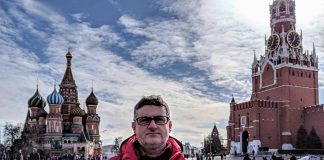
Russia’s war in Ukraine has entered a darker, more deliberate phase, marked not merely by military manoeuvre but by a sustained assault on civilian life, according to James Ford.
That, at least, is the unmistakable message delivered by the United Kingdom in its latest address to the Organization for Security and Co-operation in Europe (OSCE)—a forum long accustomed to diplomatic caution, but now confronted with what London describes as a grim and escalating pattern.
Speaking on behalf of the UK, Deputy Ambassador James Ford offered a stark assessment: the intensification of Russian missile and drone strikes is no fleeting surge but part of a calculated campaign. Ukrainian cities, he argued, are being subjected to repeated and deliberate attack, with civilians bearing the brunt.
The evidence, as presented, is difficult to dismiss. In cities such as Dnipro, residential districts have been struck with devastating effect. Apartment blocks have been shattered, infrastructure reduced to rubble, and lives—among them those of children—lost or irreparably altered. The cumulative effect is not simply physical destruction, but a broader attempt to erode the resilience of Ukrainian society.
There is, in the British view, a discernible logic to this violence. By targeting civilian centres, Russia appears intent on exhausting both morale and capacity, stretching Ukraine’s emergency services while simultaneously testing the resolve of its Western allies. Such tactics are not new in warfare, but their scale and persistence in Ukraine have drawn mounting international condemnation.
The UK’s intervention at the OSCE reflects a broader Western consensus that the conflict has shifted decisively into a phase where humanitarian concerns are paramount. While military engagements continue along the front lines, the war’s defining images increasingly come from far behind them: shattered homes, blackened schools, and hospitals operating under the constant threat of attack.
Britain has been among the most consistent supporters of Ukraine since the outset of the invasion in 2022, providing military aid, humanitarian assistance, and diplomatic backing. This latest statement underscores that continuity, reaffirming what officials describe as an “unyielding resolve” to stand with Kyiv.
Yet there is also an implicit warning embedded in the speech. By framing Russia’s actions as systematic rather than incidental, the UK is laying the groundwork for further international pressure—whether through sanctions, legal mechanisms, or enhanced military support to Ukraine. The suggestion is clear: if such attacks are indeed part of a deliberate strategy, then the response must be equally sustained and coordinated.
The OSCE, for its part, occupies an increasingly delicate position. Established during the Cold War to foster dialogue and stability across Europe, it now finds itself grappling with a conflict that has upended many of its founding assumptions. Its role as a platform for accountability and diplomatic engagement remains vital, but its capacity to influence events on the ground is inevitably constrained.
Nevertheless, forums such as these retain symbolic and practical importance. By documenting alleged violations and maintaining international scrutiny, they ensure that the war is not reduced to a distant abstraction. Each statement, each intervention, contributes to a growing body of evidence that may one day underpin legal or political reckoning.
What emerges most clearly from the UK’s address is a sense of grim continuity. Far from abating, the pressure on Ukraine’s civilian population appears to be intensifying. The war, now well into its fourth year, shows little sign of resolution, and the humanitarian toll continues to mount.
For Britain and its allies, the challenge is twofold: to sustain support for Ukraine over the long term, and to adapt to a conflict that is increasingly defined by its impact on civilians rather than purely military outcomes. The language of the UK’s statement suggests that both tasks are being taken seriously—but also that the road ahead will be neither short nor straightforward.
In the end, the speech serves as both indictment and appeal: an indictment of Russia’s conduct, as seen from London, and an appeal to the international community not to look away. In the quiet, procedural setting of the OSCE, the message carries a certain weight. It is a reminder that even amid the fog of war, the targeting of civilians remains a line that, once crossed, cannot be easily ignored.
UK Ambassador Neil Holland Exposes Russia’s Hollow Words on Peace in Blistering OSCE Address
Main Image: Gov.UK