The announcement of the World Bank’s new “Water Forward” programme arrives with the quiet urgency of a problem long deferred but no longer deniable.
Water scarcity, once framed as a regional inconvenience or a development issue confined to poorer nations, is now understood as a systemic global risk—one that cuts across economies, climates and political systems alike.
Launched in Washington this week, the initiative represents a coordinated effort by the World Bank and a constellation of multilateral lenders to address what is, by most credible estimates, an accelerating imbalance between supply and demand. Within this decade, the world is expected to face a 40 percent shortfall in freshwater availability relative to need, a figure that underscores how deeply water stress is embedded in modern economic life.
At its core, Water Forward is both ambitious and pragmatic. It aims to extend water security to as many as one billion people over the coming years, with the World Bank itself targeting 400 million beneficiaries by 2030. The scale of that ambition reflects the magnitude of the challenge: roughly four billion people already experience water scarcity at least part of the year, a statistic that transforms the issue from a niche environmental concern into a defining constraint on global development.
Yet what distinguishes this programme is not merely its scale, but its framing. The World Bank is urging governments and investors to rethink water not as a subsidised public good, but as a strategic economic resource. This shift in perspective—subtle but profound—signals a departure from decades of policy orthodoxy in which water infrastructure was often underpriced, underfunded and politically sensitive.
In practical terms, the initiative focuses on a set of targeted interventions: reducing urban leakage, modernising irrigation systems, expanding wastewater reuse, and deploying better data for planning. These are not glamorous solutions, but they are essential ones. In many cities, as much as a third of treated water is lost through outdated infrastructure. In agriculture, inefficient irrigation continues to drain aquifers at unsustainable rates.
Still, the programme’s architects appear keenly aware that technical fixes alone will not suffice. Water Forward places significant emphasis on mobilising private capital and philanthropic funding alongside public investment. This reflects a broader recognition within international finance institutions: that the scale of infrastructure required—particularly in rapidly urbanising regions of Africa, South Asia and the Middle East—cannot be met by public balance sheets alone.
There is, however, a tension embedded in this approach. Treating water as an economic asset may unlock investment, but it also raises difficult questions about affordability and equity. Pricing reforms, if poorly designed, risk placing additional burdens on vulnerable populations who already struggle with access. The history of water privatisation, particularly in parts of Latin America and Africa, offers cautionary lessons about the political and social backlash that can follow.
Moreover, the programme unfolds against a backdrop of mounting environmental strain. Climate change is intensifying both droughts and floods, disrupting hydrological cycles and complicating long-term planning. The United Nations has gone so far as to describe the current era as one of “water bankruptcy,” a term that captures not just scarcity, but the potential irreversibility of ecological damage.
In this sense, Water Forward is as much about resilience as it is about supply. Reliable water systems underpin public health, food production and energy generation. They determine whether children can attend school or must spend hours collecting water, whether businesses can operate, and whether economies can grow. The cascading effects of water insecurity—migration, conflict, economic stagnation—are increasingly visible across the globe.
The geopolitical dimension should not be overlooked. The programme’s initial focus on 14 water-stressed countries highlights regions where scarcity intersects with fragility. In such contexts, water management is not merely a technical challenge but a matter of governance and stability. Effective implementation will require not only financing, but institutional reform—stronger regulation, clearer property rights, and improved coordination across sectors.
There is also a broader strategic logic at play. By positioning water as a driver of jobs and economic growth, the World Bank is attempting to align environmental sustainability with development priorities. This is a deliberate counterpoint to the perception that climate and resource policies are constraints on growth rather than enablers of it.
Whether that narrative gains traction remains to be seen. The success of Water Forward will depend less on the elegance of its design than on the political will of participating countries and the willingness of investors to engage with what has historically been a low-return, high-risk sector.
Yet the alternative—continued underinvestment and fragmented policy—carries far greater risks. Water scarcity is not a distant threat; it is a present reality shaping the contours of economic and social life. In that context, the World Bank’s initiative may be best understood not as a solution, but as a necessary recalibration: an acknowledgment that the world’s most fundamental resource can no longer be treated as an afterthought.
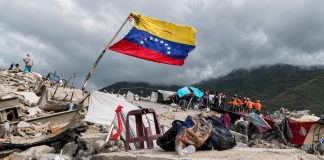
Main Image: By Thyme28 – Own work, CC BY-SA 3.0, https://commons.wikimedia.org/w/index.php?curid=19156781