In the early hours of this morning, a handful of uniformed men took over state television in Benin and declared the government dissolved.
Their message, broadcast on national airwaves, was blunt: the presidency of Patrice Talon was terminated, the constitution suspended, state institutions dismantled, and the country’s borders shut down. The men branded themselves the “Military Committee for Refoundation” and proclaimed their intention to usher in a new era of “fraternity, justice and work.”
The announcement was dramatic — almost cinematic. Soldiers, some wearing helmets, stood rigidly in front of cameras. The voice was calm. The lighting impersonal. The spectacle conjured images of a modern coup d’état — direct, simple, televised. For a brief moment, it seemed Benin’s peaceful transition toward scheduled elections might have been thrown into chaos. Overnight, the clock appeared to have reset.
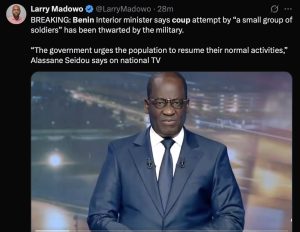
Yet by midday, the authorities were insisting the putsch had failed before it truly began. Loyalist elements of the army, officials said, had reasserted control.
The television signal had been cut. State institutions remained functional. President Talon, while out of public view in the blur of the attempted insurrection, was said to remain free, alive and in command.
It is tempting to describe what happened as a “coup attempt.” But even that term may now be too dignified for what, by all outward appearances, was little more than a crude provocation — a scramble for attention, broadcast in real time, possibly miscalculated.
For a small group of men to seize the state’s chief broadcast channel, declare themselves rulers of the nation, and order borders closed — all in the space of minutes — suggests a vainglorious gamble. It may reveal ambition in its rawest form, but ambition doesn’t always knit itself into power.
This was not the carefully choreographed overthrow of decades past, when tanks rolled into capitals and power was seized block by block. There were no columns of troops rallying in the streets. No martial law, no panicked ministers fleeing. Instead, the plotters had crystalised their plan around a single node: national television.
And that may have been their undoing. As a government spokesman put it, the mutineers only controlled the broadcast signal — not the presidential palace, not the army barracks, not the bridges or the borders. Within hours, loyal soldiers restored control. The coup, if we must call it that, collapsed under the weight of its own theatrics.
At the heart of the affair is an uncomfortable truth: the very idea of a coup in Benin was once incongruous. Under Talon’s tenure, Benin enjoyed a rare political stability in a region increasingly defined by upheaval. Presidents in power since the early 1990s had presided over ordered transitions; Talon himself had committed publicly to step down after his second term — a rare pledge among African strongmen.
But the times have changed. The wave of unrest sweeping West and Central Africa has left nearly no country untouched. Economic Community of West African States (ECOWAS) and other regional actors had warned that fragile democracies might be the next battleground for power-hungry malcontents. Benin, long thought insulated by its reforms and comparative calm, had begun to feel the tremors.
If the attempted coup fails — and for the moment it appears to have done so — the episode may nonetheless leave its mark. It exposed critical weaknesses: divisions within the military, discontent among the ranks, and a readiness among a minority to act by force. It showed that the mere trappings of democracy — elections, pledges to stand down, constitutional limits — can mask deeper fault lines.
And it showed most clearly how fragile the notion of legitimacy can prove in a crisis. A handful of troops, a television camera, a scripted declaration: for a few breathless minutes, it was as though the republic had been erased. Even if only for a moment, that glimpsed possibility will linger.
For now, Talon remains president — the institutions remain intact. The drama may conclude as a footnote. But the fact that it happened at all should feed a sobering reassessment in capitals across West Africa.
If stability can waver so easily in Benin, a country long considered a pillar of calm, then the entire region must brace for uncertainty. And if the “coup attempt” was little more than a feint — a show of force by men convinced their moment had come — then the bigger danger may still lie ahead.
Because in an age of weak institutions and simmering discontent, the next broadcast may not be interrupted so easily.